

Art as ‘pure intention’ at the Singapore Biennale
From museum halls to Lucky Plaza, art unfolds where lives are actually lived.
By Lito B. Zulueta
RUNNING since Oct. 31, 2025 until March 29 this year, the 8th edition of the Singapore Biennale coincidentally becomes part of Singapore Art Week on Jan. 22-31, unfolding across the city with a quiet but firm confidence. Commissioned by the National Arts Council and organized by the Singapore Art Museum (SAM), the Biennale marks Singapore’s 60th year as a nation while reaffirming its status as a major platform for contemporary art in Southeast Asia.
With the theme, “Pure Intention,” the biennale extends across five key locations — the Civic District, Wessex Estate, Tanglin Halt, Orchard Road, and SAM at Tanjong Pagar Distripark — transforming both familiar and overlooked spaces into sites of reflection, encounter, and critique.
The theme “pure intention” resists spectacle for spectacle’s sake. According to the curatorial team (Duncan Bass, Hsu Fang-Tze, Ong Puay Khim, and Selene Yap), the Biennale asks how art can help people see the city anew by engaging deeply with space, history, identity, and transformation.
Rather than presenting grand gestures, the exhibition privileges embeddedness: art situated within lived environments, attentive to everyday rhythms, and responsive to social realities. SAM Director Eugene Tan explained that when art is woven into the environment, it allows audiences to imagine possible futures collectively, grounded in the city’s layered past.
ORCHARD ROAD
Nowhere is this more palpable than along Orchard Road, Singapore’s iconic shopping belt.
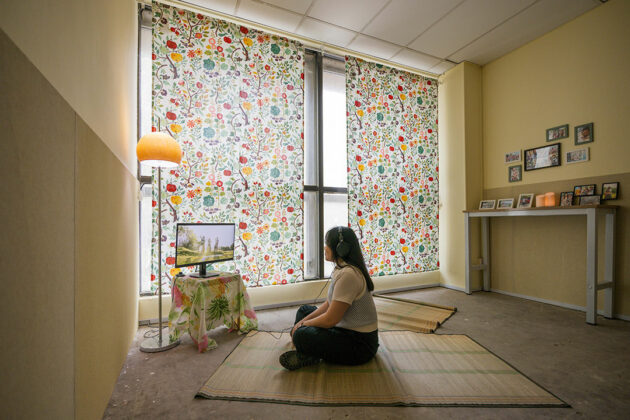
At Lucky Plaza, Filipino artist Eisa Jocson presents The Filipino Superwoman X H.O.M.E. Karaoke Living Room, an installation developed in collaboration with Filipino domestic workers.
Transforming a shop unit into a familiar Filipino living room, the work invites visitors to sing karaoke to newly produced videos that foreground resilience, humor, and collectivity.
The choice of Lucky Plaza is crucial: on Sundays, it becomes the principal social hub for Filipina domestics on their day off, making Jocson’s work inseparable from the lived realities of care, labor, and migration.
Jocson’s background as a choreographer, dancer, and visual artist deeply informs this project. Known for works such as “Death of the Pole Dancer,” “Macho Dancer,” and “Host,” Jocson interrogates how bodies — especially Filipino bodies — are disciplined, commodified, and mobilized within global economies of entertainment and service.
Her Lucky Plaza installation resonates her “Happyland” series, particularly Princess (2017), which exposed Filipino labor through a Disneyland performance. Both works show how joy, hospitality, and performance are demanded forms of labor, masking structural inequities beneath smiles and spectacle.
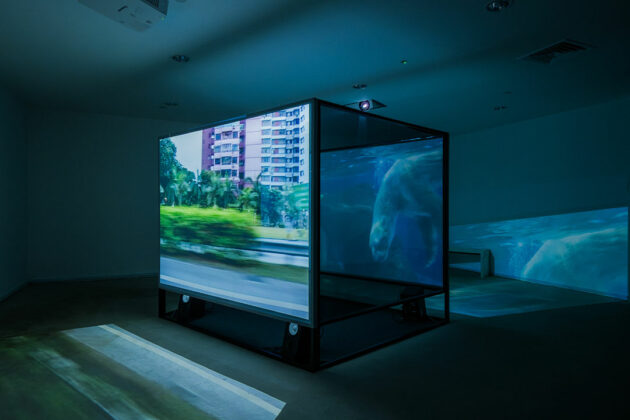
Nearby, in another mall unit, Singaporean filmmaker Tan Pin Pin’s installation juxtaposes two moving images: footage of Inuka, Singapore’s first polar bear born in captivity, swimming endlessly within an artificial Arctic enclosure; and 80km/h, a work updated annually using dashcam footage that maps the city’s relentless drive toward efficiency. Together, they stage a tension between the biological and the engineered, between cyclical life and bureaucratic speed, suggesting that progress is neither seamless nor innocent.
SAM AT TANJONG PAGAR
From Orchard Road, the Biennale’s contemplative arc leads to SAM at Tanjong Pagar Distripark. Here, history, technology, memory, and desire intersect across multiple galleries.
At the entrance, CAMP’s Metabolic Container transforms a shipping container into a living archive of trade, filled with everyday goods moving weekly between Singapore and Batam, Indonesia nearby.
Inside, Paul Chan’s Khara En Tria (Joyer in 3) animates the foyer with brightly colored figures that sway and inflate, reimagining classical ideas of the body through movement and air.
Gallery 1 brings together works that unsettle linear narratives of progress.
Pierre Huyghe’s Offspring uses AI to orchestrate light, smoke, and sound in response to environmental changes and visitor presence, creating an ever-shifting ecosystem.
Álvaro Urbano’s metallic plants evoke orchid diplomacy and plantation histories, while Cui Jie’s Thermal Landscapes paints watchtowers as surreal monuments to modernist aspiration.
Ju Young Kim’s hybrid sculptural forms merge aircraft components with Art Nouveau glass, reflecting on desire and displacement in an age of mobility.
LOST CULTURAL SPACES
Among these, Ming Wong’s Filem-Filem-Filem stands out for its quiet poignancy. Composed of digitally manipulated photographs presented in Polaroid form, the series documents abandoned and repurposed cinemas across Singapore and Malaysia.
Hyperreal yet deeply nostalgic, the images capture the faded grandeur of cinema architecture, evoking a collective memory of film-going as communal ritual. In a Biennale concerned with intention and continuity, Wong’s work gently mourns cultural spaces lost to redevelopment while affirming their lingering emotional power.
Overall, the Singapore Biennale’s 8th edition confirms its role as a sensitive barometer of contemporary art in Southeast Asia. If pure intention is measured by consistency — by sustained commitment rather than fleeting spectacle — then the SG Biennale demonstrates it through careful curatorship, site-responsive works, and ethical attentiveness.
You May Also Like

The Channel Factories We’ve Been Waiting For

XRP Escrow Amendment Gains Momentum, Set for February 2026 Activation
