NEAR Protocol reached 1 million transactions per second in benchmark tests using 70 shards, demonstrating sharding's scalability potential far beyond Visa's peak capacity. The post NEAR Achieves 1M Transactions Per Second in Sharded, Test Environment appeared first on Coinspeaker.NEAR Protocol reached 1 million transactions per second in benchmark tests using 70 shards, demonstrating sharding's scalability potential far beyond Visa's peak capacity. The post NEAR Achieves 1M Transactions Per Second in Sharded, Test Environment appeared first on Coinspeaker.

NEAR Achieves 1M Transactions Per Second in Sharded, Test Environment

NEAR Protocol NEAR $1.75 24h volatility: 1.1% Market cap: $2.24 B Vol. 24h: $188.81 M has achieved a significant milestone of 1 million transactions per second (TPS) in a benchmark test environment created to simulate a real-world scenario. This development helps to demonstrate sharding is an efficient method for high scalability and throughput capacity for high-performance blockchains—surpassing Visa’s peak capacity of around 65,000 transactions per second.

The NEAR Foundation reported this recent achievement in a blog post on Dec. 8, explaining the benchmark’s methodology in “a publicly verifiable benchmark using real code, realistic workloads, and cost-effective and performant Google Compute Engine C4D machines across 70 shards,” as described.

Results are available in three Grafana dashboards that achieved 1,029,497, 1,037,334, and 1,037,495 transactions per second peaks, followed by a constant one million TPS performance for nearly one hour each.
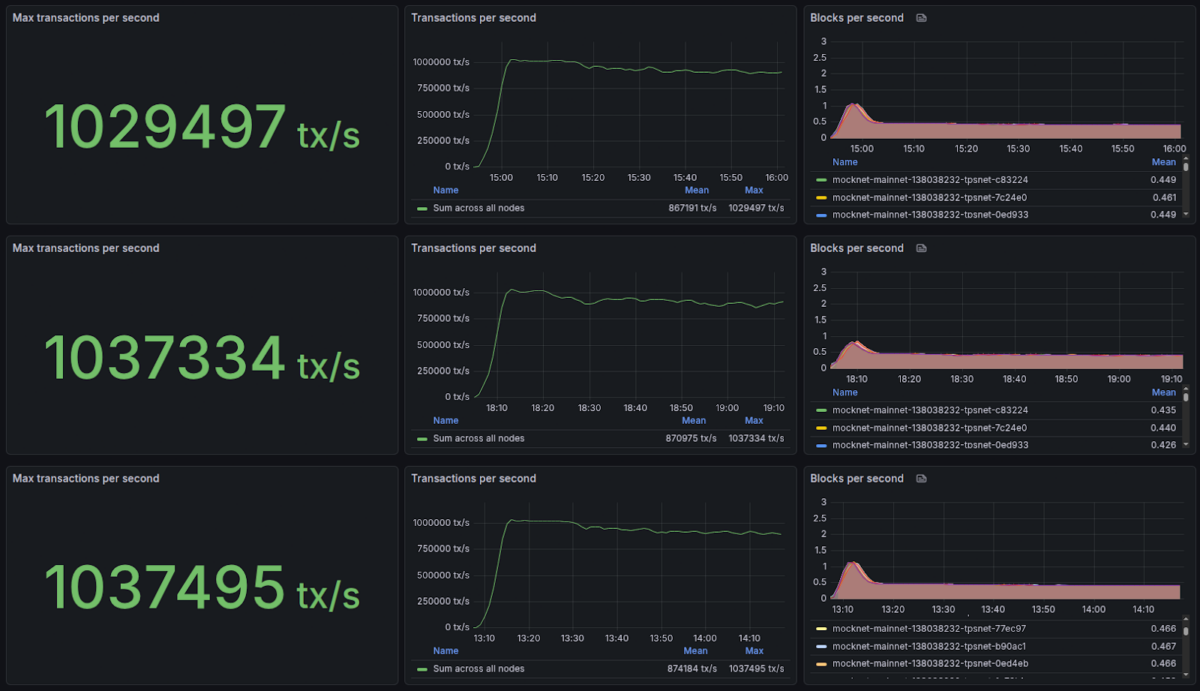
Grafana dashboards for three NEAR Protocol 1M-TPS tests | Source: NEAR Foundation/Grafana

Grafana dashboards for three NEAR Protocol 1M-TPS tests | Source: NEAR Foundation/Grafana

As described in the blog post, this benchmark had validators split in 70 shards, running commercial-grade hardware from Google Cloud, with an approximate cost of $900 per month. While accessible, this cost is significantly higher than the minimum required to run chunk validators on NEAR—currently estimated at $15 per month, according to Meta Pool’s Node Studio.

This test used only native token transfers, not broadcasting smart contract executions that require more network gas and computational power, which could reduce the overall capacity per second. Moreover, the NEAR blockchain currently has nine shards and not the 70 shards used for the tests, meaning the current mainnet capacity is likely orders of magnitude below the achieved one million transactions per second.

Nevertheless, it suggests NEAR Protocol is ready, with enough optimizations, to scale at any moment to something close to 1 million TPS with consistency and network reliability as adoptions and demand for block space grows.

How Many TPS Other Blockchains and Payment Processors Can Achieve?

Interestingly, Visa (NYSE: V) can scale to 65,000 transactions per second, according to The Banking Scene. In 2024, Visa processed an average of approximately 25,091 transactions per second globally, based on the total of roughly 293 billion payment transactions handled that year.

Data Coinspeaker gathered from Chainspect on Dec. 8 shows the theoretical maximum TPS other blockchains can achieve, based on benchmark tests like the one provided by NEAR, or rough calculations by the Chainspect analysts.

When comparing with some of the largest cryptocurrencies by market cap, Sonic, ICP, and Aptos have the largest maximum theoretical TPS after NEAR, with nearly 400,000, 210,000, and 160,000 transactions per second, respectively.

Sui SUI $1.61 24h volatility: 0.9% Market cap: $6.01 B Vol. 24h: $995.44 M , TON TON $1.63 24h volatility: 1.4% Market cap: $3.98 B Vol. 24h: $135.10 M , Polkadot DOT $2.12 24h volatility: 0.7% Market cap: $3.49 B Vol. 24h: $192.42 M , and Solana SOL $134.4 24h volatility: 1.0% Market cap: $75.38 B Vol. 24h: $5.34 B follow suit, with approximately 120,000, 105,000, 100,000, and 65,000 TPS, respectively. However, SOL is the one with the highest “Real-Time TPS” across all blockchains on Chainspect—at 1,238 transactions per second by the time of this writing.
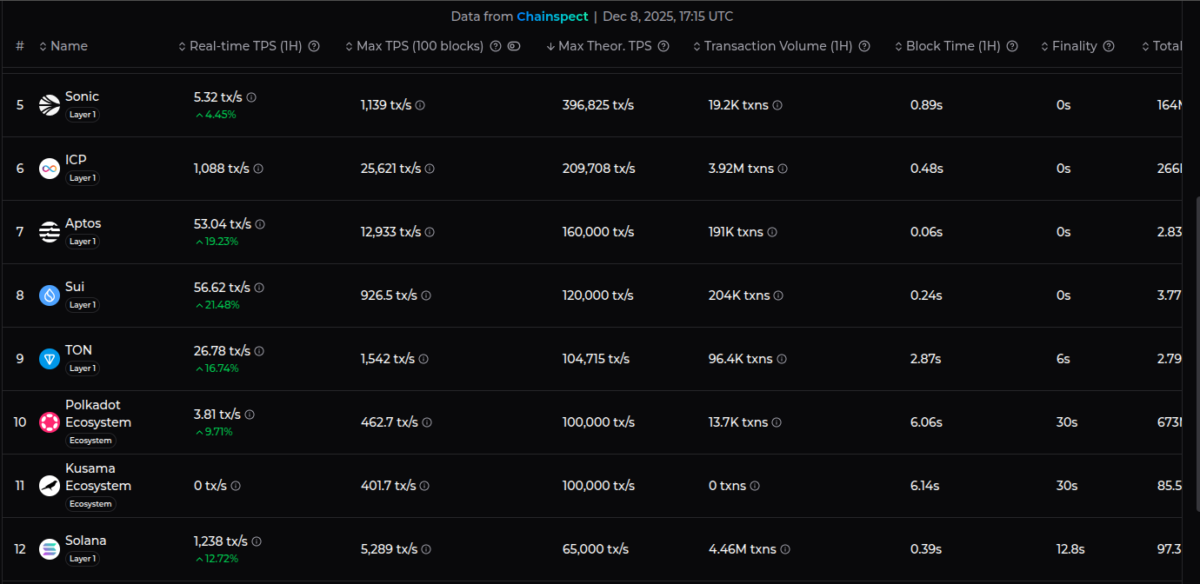
Fastest blockchains by transactions per second (TPS), as of Dec. 8 | Source: Coinspect

Fastest blockchains by transactions per second (TPS), as of Dec. 8 | Source: Coinspect

Therefore, this recent achievement positions NEAR as one of the layer-one blockchain networks with the highest theoretical capacity and scalability. This adds up to recent positive developments in the NEAR ecosystem, as Coinspeaker has covered and reported about.

On Dec. 5, NEAR launched TravAI, together with ADI Chain, where AI agents handle complete travel booking workflows from search to payment using crypto. On Dec. 3, the foundation announced NEAR AI Cloud and Private Chat, two related products that were already integrated by relevant players like the Brave Browser. Kalshi also recently added support to NEAR’s native token and NEAR Intents surpassed the $7 billion mark for its chain-abstracted swaps all-time volume.

next

The post NEAR Achieves 1M Transactions Per Second in Sharded, Test Environment appeared first on Coinspeaker.

Market Opportunity
NEAR Logo
NEAR Price(NEAR)
$1.305
$1.305$1.305
-4.95%
USD
NEAR (NEAR) Live Price Chart
Disclaimer: The articles reposted on this site are sourced from public platforms and are provided for informational purposes only. They do not necessarily reflect the views of MEXC. All rights remain with the original authors. If you believe any content infringes on third-party rights, please contact service@support.mexc.com for removal. MEXC makes no guarantees regarding the accuracy, completeness, or timeliness of the content and is not responsible for any actions taken based on the information provided. The content does not constitute financial, legal, or other professional advice, nor should it be considered a recommendation or endorsement by MEXC.

You May Also Like

21Shares Launches JitoSOL Staking ETP on Euronext for European Investors

21Shares Launches JitoSOL Staking ETP on Euronext for European Investors

21Shares launches JitoSOL staking ETP on Euronext, offering European investors regulated access to Solana staking rewards with additional yield opportunities.Read
Share
Coinstats2026/01/30 12:53
Digital Asset Infrastructure Firm Talos Raises $45M, Valuation Hits $1.5 Billion

Digital Asset Infrastructure Firm Talos Raises $45M, Valuation Hits $1.5 Billion

Robinhood, Sony and trading firms back Series B extension as institutional crypto trading platform expands into traditional asset tokenization
Share
Blockhead2026/01/30 13:30
Summarize Any Stock’s Earnings Call in Seconds Using FMP API

Summarize Any Stock’s Earnings Call in Seconds Using FMP API

Turn lengthy earnings call transcripts into one-page insights using the Financial Modeling Prep APIPhoto by Bich Tran Earnings calls are packed with insights. They tell you how a company performed, what management expects in the future, and what analysts are worried about. The challenge is that these transcripts often stretch across dozens of pages, making it tough to separate the key takeaways from the noise. With the right tools, you don’t need to spend hours reading every line. By combining the Financial Modeling Prep (FMP) API with Groq’s lightning-fast LLMs, you can transform any earnings call into a concise summary in seconds. The FMP API provides reliable access to complete transcripts, while Groq handles the heavy lifting of distilling them into clear, actionable highlights. In this article, we’ll build a Python workflow that brings these two together. You’ll see how to fetch transcripts for any stock, prepare the text, and instantly generate a one-page summary. Whether you’re tracking Apple, NVIDIA, or your favorite growth stock, the process works the same — fast, accurate, and ready whenever you are. Fetching Earnings Transcripts with FMP API The first step is to pull the raw transcript data. FMP makes this simple with dedicated endpoints for earnings calls. If you want the latest transcripts across the market, you can use the stable endpoint /stable/earning-call-transcript-latest. For a specific stock, the v3 endpoint lets you request transcripts by symbol, quarter, and year using the pattern: https://financialmodelingprep.com/api/v3/earning_call_transcript/{symbol}?quarter={q}&year={y}&apikey=YOUR_API_KEY here’s how you can fetch NVIDIA’s transcript for a given quarter: import requestsAPI_KEY = "your_api_key"symbol = "NVDA"quarter = 2year = 2024url = f"https://financialmodelingprep.com/api/v3/earning_call_transcript/{symbol}?quarter={quarter}&year={year}&apikey={API_KEY}"response = requests.get(url)data = response.json()# Inspect the keysprint(data.keys())# Access transcript contentif "content" in data[0]: transcript_text = data[0]["content"] print(transcript_text[:500]) # preview first 500 characters The response typically includes details like the company symbol, quarter, year, and the full transcript text. If you aren’t sure which quarter to query, the “latest transcripts” endpoint is the quickest way to always stay up to date. Cleaning and Preparing Transcript Data Raw transcripts from the API often include long paragraphs, speaker tags, and formatting artifacts. Before sending them to an LLM, it helps to organize the text into a cleaner structure. Most transcripts follow a pattern: prepared remarks from executives first, followed by a Q&A session with analysts. Separating these sections gives better control when prompting the model. In Python, you can parse the transcript and strip out unnecessary characters. A simple way is to split by markers such as “Operator” or “Question-and-Answer.” Once separated, you can create two blocks — Prepared Remarks and Q&A — that will later be summarized independently. This ensures the model handles each section within context and avoids missing important details. Here’s a small example of how you might start preparing the data: import re# Example: using the transcript_text we fetched earliertext = transcript_text# Remove extra spaces and line breaksclean_text = re.sub(r'\s+', ' ', text).strip()# Split sections (this is a heuristic; real-world transcripts vary slightly)if "Question-and-Answer" in clean_text: prepared, qna = clean_text.split("Question-and-Answer", 1)else: prepared, qna = clean_text, ""print("Prepared Remarks Preview:\n", prepared[:500])print("\nQ&A Preview:\n", qna[:500]) With the transcript cleaned and divided, you’re ready to feed it into Groq’s LLM. Chunking may be necessary if the text is very long. A good approach is to break it into segments of a few thousand tokens, summarize each part, and then merge the summaries in a final pass. Summarizing with Groq LLM Now that the transcript is clean and split into Prepared Remarks and Q&A, we’ll use Groq to generate a crisp one-pager. The idea is simple: summarize each section separately (for focus and accuracy), then synthesize a final brief. Prompt design (concise and factual) Use a short, repeatable template that pushes for neutral, investor-ready language: You are an equity research analyst. Summarize the following earnings call sectionfor {symbol} ({quarter} {year}). Be factual and concise.Return:1) TL;DR (3–5 bullets)2) Results vs. guidance (what improved/worsened)3) Forward outlook (specific statements)4) Risks / watch-outs5) Q&A takeaways (if present)Text:<<<{section_text}>>> Python: calling Groq and getting a clean summary Groq provides an OpenAI-compatible API. Set your GROQ_API_KEY and pick a fast, high-quality model (e.g., a Llama-3.1 70B variant). We’ll write a helper to summarize any text block, then run it for both sections and merge. import osimport textwrapimport requestsGROQ_API_KEY = os.environ.get("GROQ_API_KEY") or "your_groq_api_key"GROQ_BASE_URL = "https://api.groq.com/openai/v1" # OpenAI-compatibleMODEL = "llama-3.1-70b" # choose your preferred Groq modeldef call_groq(prompt, temperature=0.2, max_tokens=1200): url = f"{GROQ_BASE_URL}/chat/completions" headers = { "Authorization": f"Bearer {GROQ_API_KEY}", "Content-Type": "application/json", } payload = { "model": MODEL, "messages": [ {"role": "system", "content": "You are a precise, neutral equity research analyst."}, {"role": "user", "content": prompt}, ], "temperature": temperature, "max_tokens": max_tokens, } r = requests.post(url, headers=headers, json=payload, timeout=60) r.raise_for_status() return r.json()["choices"][0]["message"]["content"].strip()def build_prompt(section_text, symbol, quarter, year): template = """ You are an equity research analyst. Summarize the following earnings call section for {symbol} ({quarter} {year}). Be factual and concise. Return: 1) TL;DR (3–5 bullets) 2) Results vs. guidance (what improved/worsened) 3) Forward outlook (specific statements) 4) Risks / watch-outs 5) Q&A takeaways (if present) Text: <<< {section_text} >>> """ return textwrap.dedent(template).format( symbol=symbol, quarter=quarter, year=year, section_text=section_text )def summarize_section(section_text, symbol="NVDA", quarter="Q2", year="2024"): if not section_text or section_text.strip() == "": return "(No content found for this section.)" prompt = build_prompt(section_text, symbol, quarter, year) return call_groq(prompt)# Example usage with the cleaned splits from Section 3prepared_summary = summarize_section(prepared, symbol="NVDA", quarter="Q2", year="2024")qna_summary = summarize_section(qna, symbol="NVDA", quarter="Q2", year="2024")final_one_pager = f"""# {symbol} Earnings One-Pager — {quarter} {year}## Prepared Remarks — Key Points{prepared_summary}## Q&A Highlights{qna_summary}""".strip()print(final_one_pager[:1200]) # preview Tips that keep quality high: Keep temperature low (≈0.2) for factual tone. If a section is extremely long, chunk at ~5–8k tokens, summarize each chunk with the same prompt, then ask the model to merge chunk summaries into one section summary before producing the final one-pager. If you also fetched headline numbers (EPS/revenue, guidance) earlier, prepend them to the prompt as brief context to help the model anchor on the right outcomes. Building the End-to-End Pipeline At this point, we have all the building blocks: the FMP API to fetch transcripts, a cleaning step to structure the data, and Groq LLM to generate concise summaries. The final step is to connect everything into a single workflow that can take any ticker and return a one-page earnings call summary. The flow looks like this: Input a stock ticker (for example, NVDA). Use FMP to fetch the latest transcript. Clean and split the text into Prepared Remarks and Q&A. Send each section to Groq for summarization. Merge the outputs into a neatly formatted earnings one-pager. Here’s how it comes together in Python: def summarize_earnings_call(symbol, quarter, year, api_key, groq_key): # Step 1: Fetch transcript from FMP url = f"https://financialmodelingprep.com/api/v3/earning_call_transcript/{symbol}?quarter={quarter}&year={year}&apikey={api_key}" resp = requests.get(url) resp.raise_for_status() data = resp.json() if not data or "content" not in data[0]: return f"No transcript found for {symbol} {quarter} {year}" text = data[0]["content"] # Step 2: Clean and split clean_text = re.sub(r'\s+', ' ', text).strip() if "Question-and-Answer" in clean_text: prepared, qna = clean_text.split("Question-and-Answer", 1) else: prepared, qna = clean_text, "" # Step 3: Summarize with Groq prepared_summary = summarize_section(prepared, symbol, quarter, year) qna_summary = summarize_section(qna, symbol, quarter, year) # Step 4: Merge into final one-pager return f"""# {symbol} Earnings One-Pager — {quarter} {year}## Prepared Remarks{prepared_summary}## Q&A Highlights{qna_summary}""".strip()# Example runprint(summarize_earnings_call("NVDA", 2, 2024, API_KEY, GROQ_API_KEY)) With this setup, generating a summary becomes as simple as calling one function with a ticker and date. You can run it inside a notebook, integrate it into a research workflow, or even schedule it to trigger after each new earnings release. Free Stock Market API and Financial Statements API... Conclusion Earnings calls no longer need to feel overwhelming. With the Financial Modeling Prep API, you can instantly access any company’s transcript, and with Groq LLM, you can turn that raw text into a sharp, actionable summary in seconds. This pipeline saves hours of reading and ensures you never miss the key results, guidance, or risks hidden in lengthy remarks. Whether you track tech giants like NVIDIA or smaller growth stocks, the process is the same — fast, reliable, and powered by the flexibility of FMP’s data. Summarize Any Stock’s Earnings Call in Seconds Using FMP API was originally published in Coinmonks on Medium, where people are continuing the conversation by highlighting and responding to this story
Share
Medium2025/09/18 14:40