The crypto market has lost over $15 billion to hackers, with a fifth of it lost in bridge exploits, which Chainlink says highlights the need for its cross-chainThe crypto market has lost over $15 billion to hackers, with a fifth of it lost in bridge exploits, which Chainlink says highlights the need for its cross-chain

$2.8 Billion Lost to Exploits Highlights Need for Chainlink’s Cross-Chain Solution

3 min read
  • The crypto market has lost over $15 billion to hackers, with a fifth of it lost in bridge exploits, which Chainlink says highlights the need for its cross-chain solution.
  • Cross-chain interoperability only works if security is built in, moving away from centralized single points of failure, the network says.

The crypto market has continued to be a prime target for cyber criminals, who keep making away with billions of dollars every year. Cross-chain bridges are among the most vulnerable, and according to Chainlink, its cross-chain infrastructure is the ultimate solution.

In 2025, hackers stole $2.87 billion in 147 hacks, a new report by TRM Labs reveals. While it’s the lowest number of hacks in the past four years, the average per incident is the highest in three years at $19.5 million. The Bybit hack in February was the largest by far, with hackers stealing over $1.4 billion, as we reported.

Cumulatively, hackers have stolen $15.8 billion since 2016, data from DeFiLlama shows. DeFi is the most targeted ecosystem, losing over $7 billion to these criminals. In recent years, cross-chain bridges have become another goldmine for the hackers, with $2.89 billion lost.

ChainlinkData courtesy of DeFiLlama.

This is where Chainlink can provide a solution, the network says, adding, “Exploits are a problem that is solved through sound architecture and a rigorous security-first approach.”

A cross-chain bridge is a tool that allows users to move crypto assets or data from one chain to another. While there are dozens of bridges, Wormhole and LayerZero remain among the most popular.

As Chainlink points out, most bridges rely on one security layer with a small validator set, one oracle network and one relayer. This security is weak as validators can get hacked, or private keys can be leaked, and this would give hackers access to users’ assets.

Defense in depth is the best approach, with “multiple decentralized networks working to secure a single cross-chain transaction,” Chainlink says.

The Cross-Chain Interoperability Protocol (CCIP) remains the industry standard for cross-chain messaging, Chainlink says. CCIP is the only defense-in-depth solution that offers multiple decentralized oracle networks to verify the cross-chain messages. If one oracle is compromised or sends the wrong data, the others can block it.

CCIP also offers configurable rate limits and circuit breakers which can pause a transfer midway if anything looks off. Other solutions only attend to the suspicious activity after the damage is done.
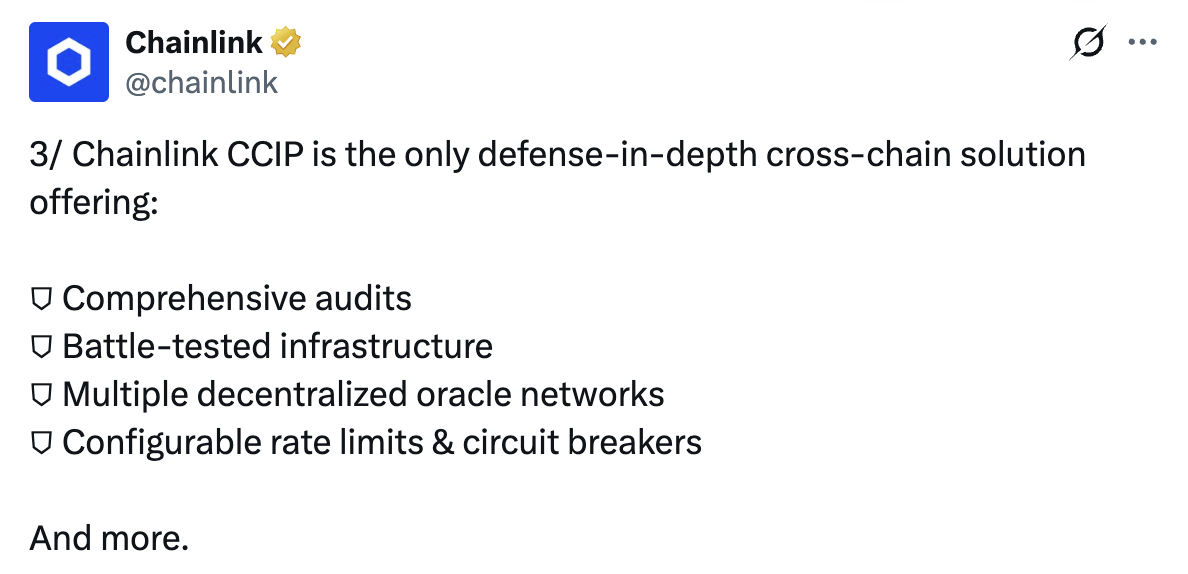
ChainlinkImage courtesy of Chainlink.

Chainlink’s infrastructure is already battle-tested and is used to secure most high-profile exchanges, DeFi platforms and crypto services. As we reported, it has enabled the movement of over $27 trillion and relayed 19 billion messages for over 2,500 projects.

LINK trades at $9.58, losing 19.2% in the past week for a $6.78 billion market cap.

]]>
Disclaimer: The articles reposted on this site are sourced from public platforms and are provided for informational purposes only. They do not necessarily reflect the views of MEXC. All rights remain with the original authors. If you believe any content infringes on third-party rights, please contact service@support.mexc.com for removal. MEXC makes no guarantees regarding the accuracy, completeness, or timeliness of the content and is not responsible for any actions taken based on the information provided. The content does not constitute financial, legal, or other professional advice, nor should it be considered a recommendation or endorsement by MEXC.

You May Also Like

The Channel Factories We’ve Been Waiting For

The Channel Factories We’ve Been Waiting For

The post The Channel Factories We’ve Been Waiting For appeared on BitcoinEthereumNews.com. Visions of future technology are often prescient about the broad strokes while flubbing the details. The tablets in “2001: A Space Odyssey” do indeed look like iPads, but you never see the astronauts paying for subscriptions or wasting hours on Candy Crush.  Channel factories are one vision that arose early in the history of the Lightning Network to address some challenges that Lightning has faced from the beginning. Despite having grown to become Bitcoin’s most successful layer-2 scaling solution, with instant and low-fee payments, Lightning’s scale is limited by its reliance on payment channels. Although Lightning shifts most transactions off-chain, each payment channel still requires an on-chain transaction to open and (usually) another to close. As adoption grows, pressure on the blockchain grows with it. The need for a more scalable approach to managing channels is clear. Channel factories were supposed to meet this need, but where are they? In 2025, subnetworks are emerging that revive the impetus of channel factories with some new details that vastly increase their potential. They are natively interoperable with Lightning and achieve greater scale by allowing a group of participants to open a shared multisig UTXO and create multiple bilateral channels, which reduces the number of on-chain transactions and improves capital efficiency. Achieving greater scale by reducing complexity, Ark and Spark perform the same function as traditional channel factories with new designs and additional capabilities based on shared UTXOs.  Channel Factories 101 Channel factories have been around since the inception of Lightning. A factory is a multiparty contract where multiple users (not just two, as in a Dryja-Poon channel) cooperatively lock funds in a single multisig UTXO. They can open, close and update channels off-chain without updating the blockchain for each operation. Only when participants leave or the factory dissolves is an on-chain transaction…
Share
BitcoinEthereumNews2025/09/18 00:09
Markets await Fed’s first 2025 cut, experts bet “this bull market is not even close to over”

Markets await Fed’s first 2025 cut, experts bet “this bull market is not even close to over”

Will the Fed’s first rate cut of 2025 fuel another leg higher for Bitcoin and equities, or does September’s history point to caution? First rate cut of 2025 set against a fragile backdrop The Federal Reserve is widely expected to…
Share
Crypto.news2025/09/18 00:27
Best Crypto to Buy as Saylor & Crypto Execs Meet in US Treasury Council

Best Crypto to Buy as Saylor & Crypto Execs Meet in US Treasury Council

The post Best Crypto to Buy as Saylor & Crypto Execs Meet in US Treasury Council appeared on BitcoinEthereumNews.com. Michael Saylor and a group of crypto executives met in Washington, D.C. yesterday to push for the Strategic Bitcoin Reserve Bill (the BITCOIN Act), which would see the U.S. acquire up to 1M $BTC over five years. With Bitcoin being positioned yet again as a cornerstone of national monetary policy, many investors are turning their eyes to projects that lean into this narrative – altcoins, meme coins, and presales that could ride on the same wave. Read on for three of the best crypto projects that seem especially well‐suited to benefit from this macro shift:  Bitcoin Hyper, Best Wallet Token, and Remittix. These projects stand out for having a strong use case and high adoption potential, especially given the push for a U.S. Bitcoin reserve.   Why the Bitcoin Reserve Bill Matters for Crypto Markets The strategic Bitcoin Reserve Bill could mark a turning point for the U.S. approach to digital assets. The proposal would see America build a long-term Bitcoin reserve by acquiring up to one million $BTC over five years. To make this happen, lawmakers are exploring creative funding methods such as revaluing old gold certificates. The plan also leans on confiscated Bitcoin already held by the government, worth an estimated $15–20B. This isn’t just a headline for policy wonks. It signals that Bitcoin is moving from the margins into the core of financial strategy. Industry figures like Michael Saylor, Senator Cynthia Lummis, and Marathon Digital’s Fred Thiel are all backing the bill. They see Bitcoin not just as an investment, but as a hedge against systemic risks. For the wider crypto market, this opens the door for projects tied to Bitcoin and the infrastructure that supports it. 1. Bitcoin Hyper ($HYPER) – Turning Bitcoin Into More Than Just Digital Gold The U.S. may soon treat Bitcoin as…
Share
BitcoinEthereumNews2025/09/18 00:27