

Solana Validator Count Drops 70%, Fueling Decentralisation Concerns
- Solana’s active validator count has plummeted 68%, dropping from over 2,500 in 2023 to roughly 795 in early 2026.
- Smaller operators are being priced out by intense competition from zero-fee institutional validators and annual voting costs that now exceed $49,000.
- Network decentralisation is weakening, as evidenced by the Nakamoto Coefficient falling from 31 to 20, signaling that control is concentrating among fewer large-scale entities.
Solana’s validator network is shrinking fast due to economic reasons.
According to data from Solana Compass, the number of active validators has fallen from about 2,560 in early 2023 to roughly 795 today, a 68% drop. Validators are the machines that vote on blocks and keep the chain running. Fewer validators means fewer independent actors securing the network.
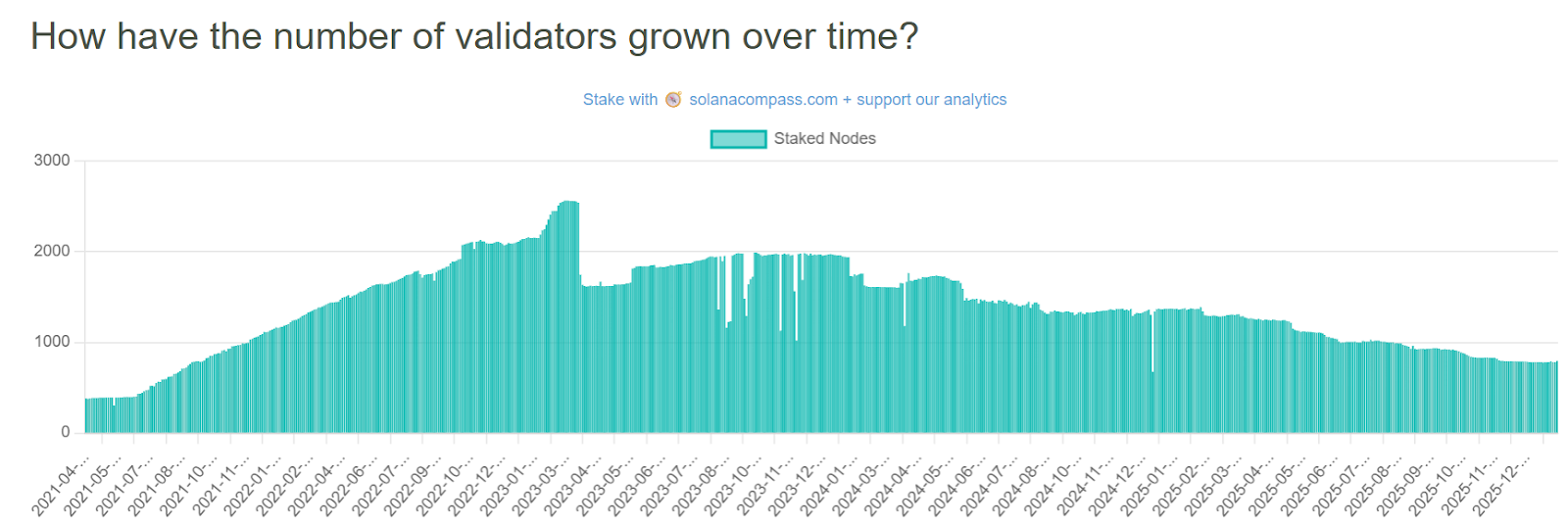 Source: Solana Compass
Some of this decline is harmless cleanup of inactive nodes. But operators say the real problem is that running a validator no longer pays for smaller players.
Read more: Solana Mobile Launches SKR Token Airdrop for Seeker Smartphone Users
Low Fees Make Operations Less Viable
For instance, Moo, an independent Solana validator, said large validators now charge 0% fees to attract stake, leaving little revenue for independents. When rewards fall below costs, smaller validators shut down.
it is becoming increasingly impossible to operate a validator profitably (…) Many small validators are actively considering shutting down. Not due to lack of belief in Solana, but because the economics no longer work. At this point, the only justification left is altruism. Loving the network and caring about decentralization is not a sustainable business model.
That pressure also shows up clearly in decentralisation metrics, as the Solana Nakamoto Coefficient, or the minimum number of independent entities needed to control a critical share of the network, has dropped from 31 to 20. In simpler words, control over Solana’s stake is becoming more concentrated in fewer hands.
The cost structure goes something like this:
- A validator must stake SOL and continuously send vote transactions to participate in consensus.
- Voting alone can cost up to about 1.1 SOL per day. Over a year, that adds up to roughly 401 SOL just to stay online.
- At current prices, the first-year requirement excluding hardware and servers is around US$49,000 (AU$75,000). For many small operators, that math doesn’t work anymore.
This doesn’t mean Solana is failing or insecure today. Large validators are professional, well-capitalised, and technically capable, but it does mean decentralisation is drifting toward institutions and large staking providers rather than individuals.
Related: Analyst: Gold’s Surge Signals a Trust Crisis – and Crypto’s Moment
The post Solana Validator Count Drops 70%, Fueling Decentralisation Concerns appeared first on Crypto News Australia.
You May Also Like

How to Pair Pearl Necklaces with Your Bridal Neckline

Shell (SHEL) Stock; Falls Modestly on U.S.-Iran Thaw and Lower Crude Prices

BitGo wins BaFIN nod to offer regulated crypto trading in Europe
BitGo’s move creates further competition in a burgeoning European crypto market that is expected to generate $26 billion revenue this year, according to one estimate. BitGo, a digital asset infrastructure company with more than $100 billion in assets under custody, has received an extension of its license from Germany’s Federal Financial Supervisory Authority (BaFin), enabling it to offer crypto services to European investors. The company said its local subsidiary, BitGo Europe, can now provide custody, staking, transfer, and trading services. Institutional clients will also have access to an over-the-counter (OTC) trading desk and multiple liquidity venues.The extension builds on BitGo’s previous Markets-in-Crypto-Assets (MiCA) license, also issued by BaFIN, and adds trading to the existing custody, transfer and staking services. BitGo acquired its initial MiCA license in May 2025, which allowed it to offer certain services to traditional institutions and crypto native companies in the European Union.Read more