A decline in ERC-20 stablecoin supply is often interpreted as liquidity exiting the cryptocurrency market. However, on-chain data from CryptoQuant shows a differentA decline in ERC-20 stablecoin supply is often interpreted as liquidity exiting the cryptocurrency market. However, on-chain data from CryptoQuant shows a different

Stablecoin Liquidity Is Shifting Networks, Not Leaving Crypto

2026/01/29 07:23
3 min read
For feedback or concerns regarding this content, please contact us at crypto.news@mexc.com

A decline in ERC-20 stablecoin supply is often interpreted as liquidity exiting the cryptocurrency market.

However, on-chain data from CryptoQuant shows a different dynamic unfolding in January 2026. Rather than leaving the system, stablecoin liquidity appears to be rotating across blockchain networks.

Stablecoin Supply Moves: January 19–20, 2026

On January 19 and 20, a clear divergence emerged between Ethereum and Tron stablecoin supplies.
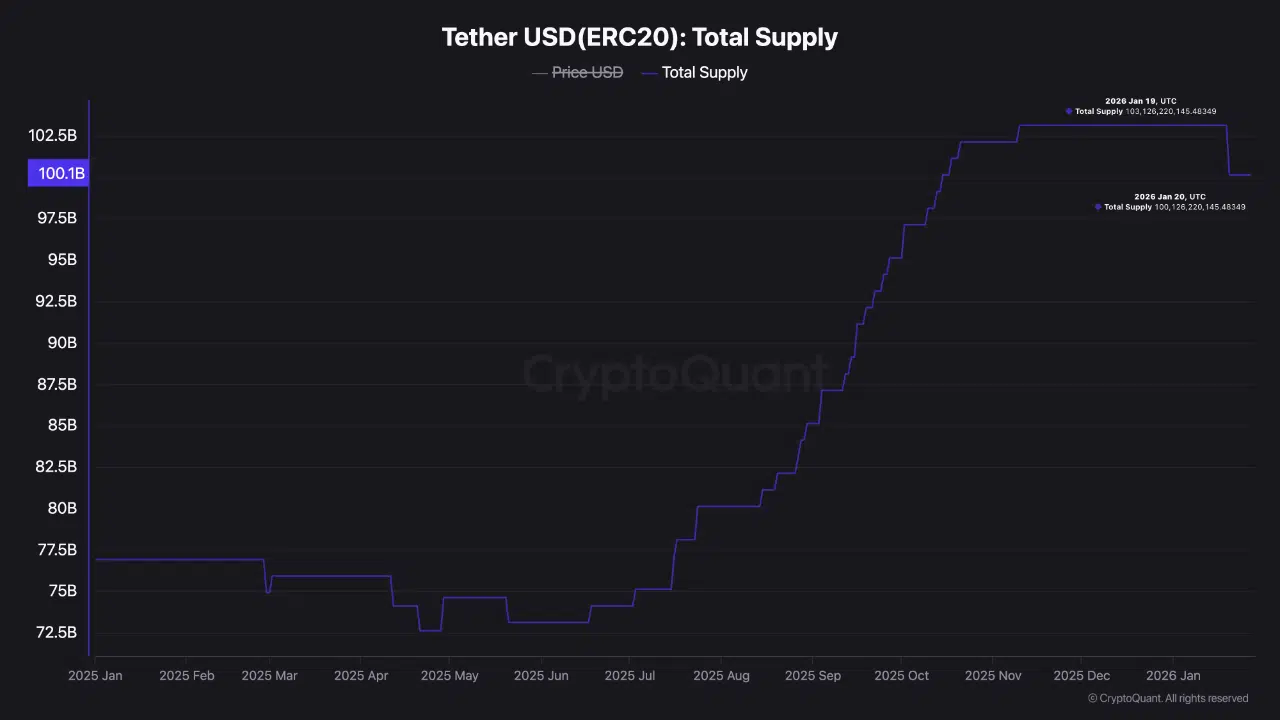
On the Tron network, USDT supply increased sharply. Total TRC-20 USDT rose from 82,434,679,540 on January 19 to 83,434,679,540 on January 20, marking a net increase of $1 billion in a single day. This expansion was driven by a direct mint on Tron.

At the same time, Ethereum experienced a notable contraction in stablecoin balances. ERC-20 USDT supply declined by approximately $3.0 billion, while ERC-20 USDC fell by around $3.55 billion. Combined, this represents roughly $6.5 billion in stablecoins removed from Ethereum-based circulation.

The timing is critical. The increase in TRC-20 USDT followed immediately after the contraction on Ethereum, suggesting a coordinated liquidity shift rather than an isolated redemption event.

What the Flow Data Indicates

This pattern does not resemble a broad exit from crypto into fiat. Instead, it reflects a redistribution of liquidity across networks and use cases.

USDT is primarily used for derivatives trading, OTC settlement, and short-term tactical positioning. Because of this role, it frequently migrates to lower-cost networks where transaction efficiency is higher. Tron has increasingly served as a preferred rail for these functions.

USDC, by contrast, is more closely tied to spot market activity and on-chain settlement. As a result, changes in ERC-20 USDC supply tend to act as a clearer signal for spot demand conditions, particularly on Ethereum.

When both USDT and USDC decline on Ethereum while USDT simultaneously expands on Tron, the most straightforward interpretation is that liquidity is changing rails, not disappearing.

OKX Launches Stablecoin Card in Europe as MiCA Takes Effect

Market Implications

The data suggests that liquidity remains inside the crypto ecosystem, but its positioning has become more defensive. Demand for Ethereum-based settlement appears to be softening, while capital preference shifts toward derivatives-oriented and parked liquidity environments.

From a market perspective, falling ERC-20 stablecoin supply carries specific implications. It is bearish for Ethereum on-chain activity, neutral to bearish for spot-driven risk appetite, and not evidence of capital exiting crypto entirely.

Rather than signaling capitulation, the stablecoin flows point to structural reallocation, a rotation within crypto infrastructure driven by cost efficiency and evolving use cases.

The post Stablecoin Liquidity Is Shifting Networks, Not Leaving Crypto appeared first on ETHNews.

Disclaimer: The articles reposted on this site are sourced from public platforms and are provided for informational purposes only. They do not necessarily reflect the views of MEXC. All rights remain with the original authors. If you believe any content infringes on third-party rights, please contact crypto.news@mexc.com for removal. MEXC makes no guarantees regarding the accuracy, completeness, or timeliness of the content and is not responsible for any actions taken based on the information provided. The content does not constitute financial, legal, or other professional advice, nor should it be considered a recommendation or endorsement by MEXC.

You May Also Like

Bitcoin ETFs Surge with 20,685 BTC Inflows, Marking Strongest Week

Bitcoin ETFs Surge with 20,685 BTC Inflows, Marking Strongest Week

TLDR Bitcoin ETFs recorded their strongest weekly inflows since July, reaching 20,685 BTC. U.S. Bitcoin ETFs contributed nearly 97% of the total inflows last week. The surge in Bitcoin ETF inflows pushed holdings to a new high of 1.32 million BTC. Fidelity’s FBTC product accounted for 36% of the total inflows, marking an 18-month high. [...] The post Bitcoin ETFs Surge with 20,685 BTC Inflows, Marking Strongest Week appeared first on CoinCentral.
Share
Coincentral2025/09/18 02:30
ZEC Rally and G Coin — Two Altcoin Setups Worth Watching

ZEC Rally and G Coin — Two Altcoin Setups Worth Watching

The post ZEC Rally and G Coin — Two Altcoin Setups Worth Watching appeared on BitcoinEthereumNews.com. The crypto market has started the week on a bullish footing
Share
BitcoinEthereumNews2026/03/19 00:58
IP Hits $11.75, HYPE Climbs to $55, BlockDAG Surpasses Both with $407M Presale Surge!

IP Hits $11.75, HYPE Climbs to $55, BlockDAG Surpasses Both with $407M Presale Surge!

The post IP Hits $11.75, HYPE Climbs to $55, BlockDAG Surpasses Both with $407M Presale Surge! appeared on BitcoinEthereumNews.com. Crypto News 17 September 2025 | 18:00 Discover why BlockDAG’s upcoming Awakening Testnet launch makes it the best crypto to buy today as Story (IP) price jumps to $11.75 and Hyperliquid hits new highs. Recent crypto market numbers show strength but also some limits. The Story (IP) price jump has been sharp, fueled by big buybacks and speculation, yet critics point out that revenue still lags far behind its valuation. The Hyperliquid (HYPE) price looks solid around the mid-$50s after a new all-time high, but questions remain about sustainability once the hype around USDH proposals cools down. So the obvious question is: why chase coins that are either stretched thin or at risk of retracing when you could back a network that’s already proving itself on the ground? That’s where BlockDAG comes in. While other chains are stuck dealing with validator congestion or outages, BlockDAG’s upcoming Awakening Testnet will be stress-testing its EVM-compatible smart chain with real miners before listing. For anyone looking for the best crypto coin to buy, the choice between waiting on fixes or joining live progress feels like an easy one. BlockDAG: Smart Chain Running Before Launch Ethereum continues to wrestle with gas congestion, and Solana is still known for network freezes, yet BlockDAG is already showing a different picture. Its upcoming Awakening Testnet, set to launch on September 25, isn’t just a demo; it’s a live rollout where the chain’s base protocols are being stress-tested with miners connected globally. EVM compatibility is active, account abstraction is built in, and tools like updated vesting contracts and Stratum integration are already functional. Instead of waiting for fixes like other networks, BlockDAG is proving its infrastructure in real time. What makes this even more important is that the technology is operational before the coin even hits exchanges. That…
Share
BitcoinEthereumNews2025/09/18 00:32