As an EV owner, home charging isn’t just about convenience anymore. With more power flowing through residential circuits and charging sessions lasting for hoursAs an EV owner, home charging isn’t just about convenience anymore. With more power flowing through residential circuits and charging sessions lasting for hours

Why I Chose a Certified Home EVDANCE EV Charger?

As an EV owner, home charging isn’t just about convenience anymore. With more power flowing through residential circuits and charging sessions lasting for hours every night, safety has become the top priority for me. That’s why, when choosing a portable EV charger, I paid close attention to certification — specifically ETL listing and compliance with the UL2594 standard.

Certification Isn’t a Bonus — It’s a Requirement

UL2594 is the key safety and performance standard for EV supply equipment in North America. Chargers tested to this standard are evaluated for how they behave not only under normal conditions, but also when something goes wrong. That includes overcurrent and overvoltage protection, thermal management, ground-fault response, durability under long high-load cycles, and even surge or lightning events.
From a consumer’s point of view, this matters a lot. A charger that hasn’t been properly tested could silently stress household wiring over time or fail to shut down correctly during a fault. That’s why I appreciated that EVDANCE emphasizes ETL-listed chargers tested to UL2594 and openly talks about what that testing covers. It gives real peace of mind.
As one EVDANCE product lead put it, “Safety is the foundation of trust in home charging.” As a user, I couldn’t agree more.

Choosing the Right Charger for Real Life

One thing I liked about EVDANCE is that they don’t push a single “one-size-fits-all” charger. Instead, they offer practical options based on how people actually live and drive.

12A Level-1 Charger — Safe and Simple

For renters, apartment dwellers, or anyone without access to a 240V outlet, the 12A Level-1 charger makes a lot of sense. It plugs into a standard NEMA 5-15 household outlet and delivers steady overnight charging.
What stood out to me is the deliberate choice of 12 amps. While a 5-15 outlet is rated for 15A, running at the maximum rating for hours can put unnecessary stress on wiring. Keeping the load at 12A is simply safer for continuous use, especially in older homes. For new EV owners, this feels like a low-risk, no-installation entry point into home charging.

24A Level-2 Charger —  Outlet Convenience

If you want faster charging but don’t want to pay for electrical upgrades, the 24A Level-2 chargers using dryer outlets are a smart middle ground. EVDANCE supports both NEMA 14-30 (newer homes) and NEMA 10-30 (older wiring), which is surprisingly hard to find elsewhere.
At 240V and 24A, these chargers can add roughly 20–25 miles of range per hour, depending on the vehicle. For most daily driving needs, that’s more than enough. The heavy-duty cable, IP66 weather resistance, and built-in fault protection make it feel robust and well thought out for everyday use.

40A Level-2 Smart Charger — When Speed and Control Matter

For drivers with higher daily mileage or tighter schedules, the 40A Level-2 smart charger stands out. With up to 9.6 kW of power, it can replenish a battery much faster overnight.
The app-based controls are a big plus: scheduling charging during off-peak hours, monitoring energy use, and starting or stopping sessions remotely. Combined with an IP66-rated enclosure and a long cable, it feels close to a fixed wall charger — just without sacrificing portability.

Practical Advice That Feels Honest

Another thing I appreciated is that EVDANCE doesn’t ignore real-world limitations. They actively recommend using dedicated outlets when possible, checking outlet and breaker conditions periodically, and consulting a licensed electrician if there’s any doubt about wiring. That kind of guidance builds trust, especially for portable chargers that might be used in different locations over time.

Built-In Protections You Don’t See — But Definitely Want

As a consumer, I may never see these systems in action, but knowing they’re there matters. Every EVDANCE charger continuously monitors current, voltage, temperature, and grounding. Overcurrent protection, overtemperature shutdown, ground-fault detection, and surge suppression are all built in. For a device that handles high power daily, that level of protection should be the baseline, not a premium feature.

Final Thoughts

From a consumer perspective, EVDANCE approach feels refreshingly practical. Instead of flashy marketing, the focus is on certification, real electrical limits, and matching products to actual living situations. In a world where home charging is becoming a long-term daily habit, that emphasis on safety and transparency is exactly what I look for .
EVDANCE Shop at https://evdances.com/,enjoy EV charging freedom wherever you go.
Comments
Market Opportunity
WHY Logo
WHY Price(WHY)
$0.00000001895
$0.00000001895$0.00000001895
0.00%
USD
WHY (WHY) Live Price Chart
Disclaimer: The articles reposted on this site are sourced from public platforms and are provided for informational purposes only. They do not necessarily reflect the views of MEXC. All rights remain with the original authors. If you believe any content infringes on third-party rights, please contact service@support.mexc.com for removal. MEXC makes no guarantees regarding the accuracy, completeness, or timeliness of the content and is not responsible for any actions taken based on the information provided. The content does not constitute financial, legal, or other professional advice, nor should it be considered a recommendation or endorsement by MEXC.

You May Also Like

Santander’s Openbank Sparks Crypto Frenzy in Germany

Santander’s Openbank Sparks Crypto Frenzy in Germany

 In Germany, the digital bank Santander Openbank introduces trading in crypto, which offers BTC, ETH, LTC, POL, and ADA in the MiCA framework of the EU. Santander, the largest bank in Spain, has officially introduced cryptocurrency trading to its clients in Germany, using its digital division, Openbank.  With this new service, users can purchase, sell, […] The post Santander’s Openbank Sparks Crypto Frenzy in Germany appeared first on Live Bitcoin News.
Share
LiveBitcoinNews2025/09/18 04:30
The GENIUS Act Is Already Law. Banks Shouldn’t Try to Rewrite It Now

The GENIUS Act Is Already Law. Banks Shouldn’t Try to Rewrite It Now

The post The GENIUS Act Is Already Law. Banks Shouldn’t Try to Rewrite It Now appeared on BitcoinEthereumNews.com. Healthy competition drives innovation and better products for consumers; it is at the center of American economic leadership. Unfortunately, now that the bipartisan GENIUS Act has been signed into law, major legacy financial institutions seem to be having second thoughts about the innovations that stablecoins can bring to financial markets. Bank lobbying groups and public affairs teams have been peppering Congress with complaints about the law, urging members to reopen debate and introduce changes to the legislation that will ensure the stablecoin market doesn’t grow too quickly, protecting banks’ profits and stifling consumer choice. This reactionary response is both overblown and unnecessary. What legacy financial firms should do instead is embrace competition and offer exciting new products and services that consumers want, not try to kneecap emerging players through anti-innovation rules and regulations. The GENIUS Act was carefully designed with a thorough bipartisan process to strengthen consumer safeguards, ensure regulatory oversight, and preserve financial stability. Efforts to roll back its provisions are less about protecting families and more about protecting entrenched banking interests from the competition that helps ensure the U.S. banking system stays the strongest and most innovative in the world. Critics warn that allowing stablecoins to provide rewards could lead to massive deposit outflows from community banks, with figures as high as $6.6 trillion cited. But closer examination shows this fear is unfounded. A July 2025 analysis by consulting firm Charles River Associates found no statistically significant relationship between stablecoin adoption and community bank deposit outflows. In fact, the overwhelming majority of stablecoin reserves remain in the traditional financial system — either in commercial bank accounts or in short-term Treasuries — where they continue to support liquidity and credit in the broader U.S. economy. The dire estimates rely on unrealistic assumptions that every dollar of stablecoin issuance permanently…
Share
BitcoinEthereumNews2025/09/18 09:39
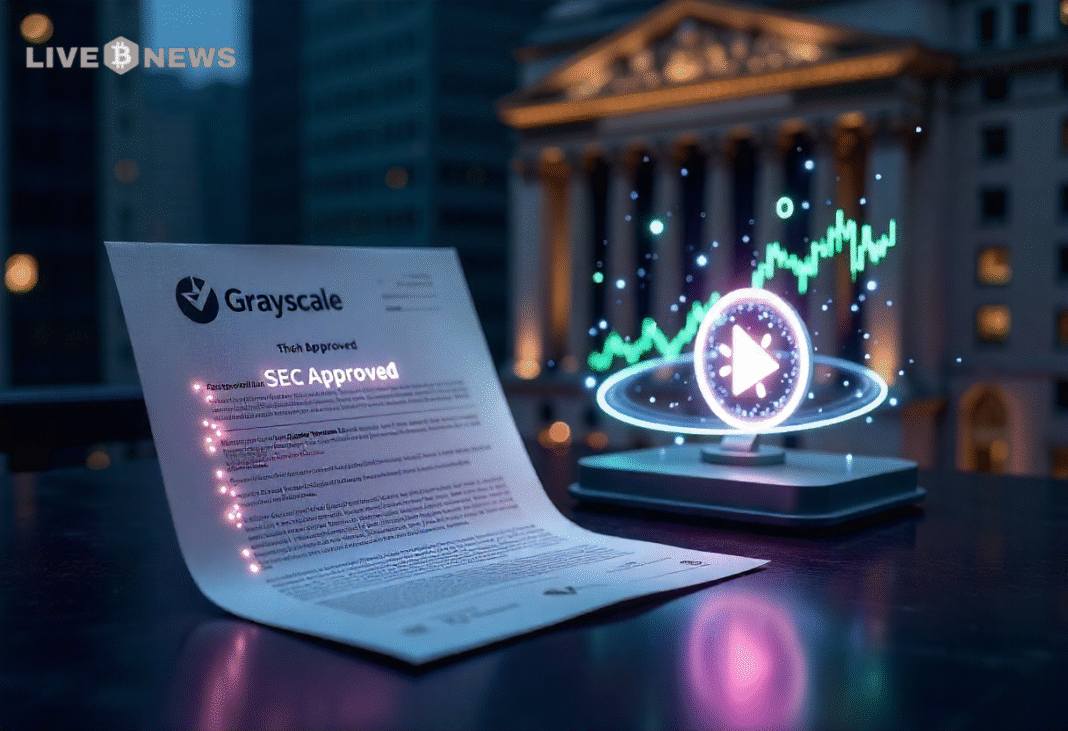
Grayscale’s GDLC Fund, Holding SOL and ADA, Receives SEC Approval for NYSE Listing

Grayscale’s GDLC Fund, Holding SOL and ADA, Receives SEC Approval for NYSE Listing

Grayscale’s GDLC Fund, holding BTC, ETH, XRP, SOL, and ADA, receives SEC approval to list on NYSE Arca, offering crypto exposure.   Grayscale’s Digital Large Cap Fund (GDLC) holds major cryptocurrencies like Bitcoin, Ethereum, XRP, Solana, and Cardano. The U.S. SEC has approved GDLC to list on NYSE Arca. This gives investors regulated access to […] The post Grayscale’s GDLC Fund, Holding SOL and ADA, Receives SEC Approval for NYSE Listing appeared first on Live Bitcoin News.
Share
LiveBitcoinNews2025/09/18 19:30