The Polish parliament has finally approved a government-proposed crypto bill that has become the focal point of a heated political clash with the head of state The Polish parliament has finally approved a government-proposed crypto bill that has become the focal point of a heated political clash with the head of state

Poland adopts controversial crypto law designed to localize MiCA rules

The Polish parliament has finally approved a government-proposed crypto bill that has become the focal point of a heated political clash with the head of state and the opposition.

The legislation, strongly criticized by the industry as a threat to domestic crypto business, has been pushed through after an earlier attempt to overturn President Karol Nawrocki’s veto failed.

Polish lawmakers adopt crypto law vetoed by Nawrocki

The Sejm, the lower house of parliament in Poland, has adopted the country’s new Crypto-Asset Market Act, local media reported.

On Thursday, the comprehensive framework was backed by 241 members of the chamber, out of a total of 425 deputies participating in the vote.

This was the second reading of the bill, which took place after Karol Nawrocki returned it to the legislature in early December. It was initially passed in September.

The first try to override the president’s veto was unsuccessful as the parties forming the ruling coalition were unable to provide the three-fifths majority needed to achieve that.

The legislation is supposedly designed to transpose the EU’s latest Markets in Crypto Assets (MiCA) regulations into national law.

However, the country’s crypto community is warning that it goes far beyond the European requirements, threatening the very survival of Polish platforms. Many of them are expected to exit what’s now arguably Eastern Europe’s largest cryptocurrency market.

Crypto Act stirs political storm in Warsaw

In his motives for the veto, Nawrocki added his own concerns, including regarding the personal and economic freedoms of Poles and the very stability of their state.

The pro-EU government of Prime Minister Donald Tusk returned fire by accusing the president of involvement in a “crypto affair” and “weird relationship” with the industry.

After the first failed attempt to overturn the veto of the recently elected nationalist head of state, Tusk portrayed the adoption of the legislation as a matter of national security.

Addressing the Sejm during a partially closed-door session, he alleged that Poland’s crypto sector has been infiltrated by over a hundred foreign entities, many from Russia, Belarus and other former-Soviet states.

Quoted by Polish media and Bloomberg, he insisted that his cabinet’s draft gives Warsaw “tools to control a new market, which is not regulated, where the Russian services, Russian mafia and money laundering are present.”

Cryptocurrencies have been used by Moscow to finance subversive actions in the country and to circumvent Western sanctions imposed over its invasion of Ukraine, he claimed, adding that Nawrocki’s stoppage was serving the interests of Putin’s regime.

Members of Tusk’s cabinet indicated they are resubmitting the bill to parliament without any major changes, and the Premier himself turned directly to the president with a “Please, do not disturb” appeal, as quoted by a leading Polish crypto news outlet.

Poland’s crypto industry wants to know what’s next

The approved legal document, which contains more than 100 pages of new provisions, is not merely a transposition of European law, Bitcoin.pl noted after the Sejm’s vote, elaborating in an article:

The watchdog, abbreviated KNF in Polish, “receives the tools it could only dream of until now: the ability to suspend the activities of platforms, impose financial penalties reaching millions of zlotys and control every move on the crypto-asset market,” the portal added.

It also suggested that Polish crypto exchanges, brokers and blockchain projects should now prepare for a new era of government bureaucracy, including capital, licensing, and reporting requirements.

“The list of responsibilities is growing at an alarming rate,” the crypto-focused website remarked, issuing another stark warning:

The Crypto-Asset Market Act is sowing division among representatives of the sector as well. Some insist that MiCA will bring necessary standardization and protection for investors.

Others say its Polish interpretation will suffocate innovation and chase businesses away to friendlier jurisdictions such as Malta or the Baltics.

The publication highlights that the crypto law has become the main cause for skirmishes on the battleground of Polish politics in recent weeks, with PR often blurring the important matter. It believes Karol Nawrocki is likely to once again halt Tusk’s legislation.

Get up to $30,050 in trading rewards when you join Bybit today

Market Opportunity
Clash Logo
Clash Price(CLASH)
$0.021302
$0.021302$0.021302
+0.95%
USD
Clash (CLASH) Live Price Chart
Disclaimer: The articles reposted on this site are sourced from public platforms and are provided for informational purposes only. They do not necessarily reflect the views of MEXC. All rights remain with the original authors. If you believe any content infringes on third-party rights, please contact service@support.mexc.com for removal. MEXC makes no guarantees regarding the accuracy, completeness, or timeliness of the content and is not responsible for any actions taken based on the information provided. The content does not constitute financial, legal, or other professional advice, nor should it be considered a recommendation or endorsement by MEXC.

You May Also Like

Building a DEXScreener Clone: A Step-by-Step Guide

Building a DEXScreener Clone: A Step-by-Step Guide

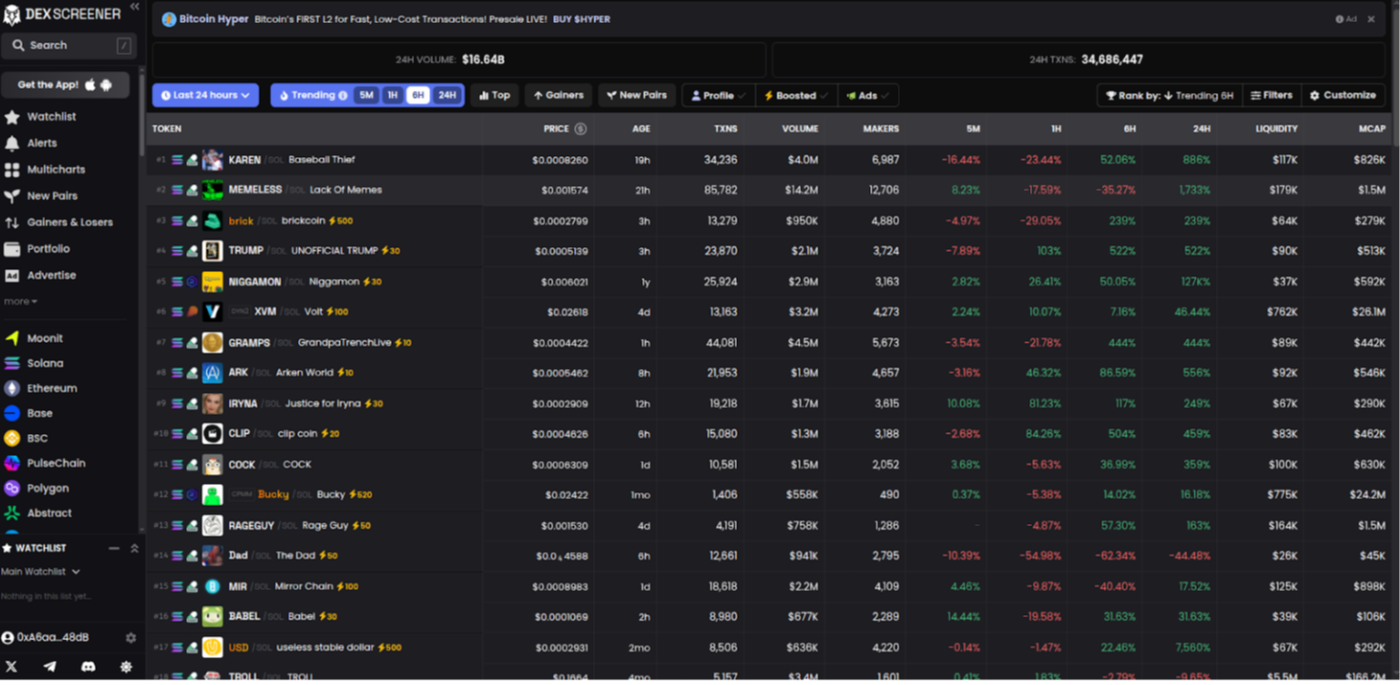
DEX Screener is used by crypto traders who need access to on-chain data like trading volumes, liquidity, and token prices. This information allows them to analyze trends, monitor new listings, and make informed investment decisions. In this tutorial, I will build a DEXScreener clone from scratch, covering everything from the initial design to a functional app. We will use Streamlit, a Python framework for building full-stack apps.
Share
Hackernoon2025/09/18 15:05
Which DOGE? Musk's Cryptic Post Explodes Confusion

Which DOGE? Musk's Cryptic Post Explodes Confusion

A viral chart documenting a sharp decline in U.S. federal employment during President Trump's second term has sparked unexpected confusion in cryptocurrency markets
Share
Coinstats2025/12/20 01:13
Google's AP2 protocol has been released. Does encrypted AI still have a chance?

Google's AP2 protocol has been released. Does encrypted AI still have a chance?

Following the MCP and A2A protocols, the AI Agent market has seen another blockbuster arrival: the Agent Payments Protocol (AP2), developed by Google. This will clearly further enhance AI Agents' autonomous multi-tasking capabilities, but the unfortunate reality is that it has little to do with web3AI. Let's take a closer look: What problem does AP2 solve? Simply put, the MCP protocol is like a universal hook, enabling AI agents to connect to various external tools and data sources; A2A is a team collaboration communication protocol that allows multiple AI agents to cooperate with each other to complete complex tasks; AP2 completes the last piece of the puzzle - payment capability. In other words, MCP opens up connectivity, A2A promotes collaboration efficiency, and AP2 achieves value exchange. The arrival of AP2 truly injects "soul" into the autonomous collaboration and task execution of Multi-Agents. Imagine AI Agents connecting Qunar, Meituan, and Didi to complete the booking of flights, hotels, and car rentals, but then getting stuck at the point of "self-payment." What's the point of all that multitasking? So, remember this: AP2 is an extension of MCP+A2A, solving the last mile problem of AI Agent automated execution. What are the technical highlights of AP2? The core innovation of AP2 is the Mandates mechanism, which is divided into real-time authorization mode and delegated authorization mode. Real-time authorization is easy to understand. The AI Agent finds the product and shows it to you. The operation can only be performed after the user signs. Delegated authorization requires the user to set rules in advance, such as only buying the iPhone 17 when the price drops to 5,000. The AI Agent monitors the trigger conditions and executes automatically. The implementation logic is cryptographically signed using Verifiable Credentials (VCs). Users can set complex commission conditions, including price ranges, time limits, and payment method priorities, forming a tamper-proof digital contract. Once signed, the AI Agent executes according to the conditions, with VCs ensuring auditability and security at every step. Of particular note is the "A2A x402" extension, a technical component developed by Google specifically for crypto payments, developed in collaboration with Coinbase and the Ethereum Foundation. This extension enables AI Agents to seamlessly process stablecoins, ETH, and other blockchain assets, supporting native payment scenarios within the Web3 ecosystem. What kind of imagination space can AP2 bring? After analyzing the technical principles, do you think that's it? Yes, in fact, the AP2 is boring when it is disassembled alone. Its real charm lies in connecting and opening up the "MCP+A2A+AP2" technology stack, completely opening up the complete link of AI Agent's autonomous analysis+execution+payment. From now on, AI Agents can open up many application scenarios. For example, AI Agents for stock investment and financial management can help us monitor the market 24/7 and conduct independent transactions. Enterprise procurement AI Agents can automatically replenish and renew without human intervention. AP2's complementary payment capabilities will further expand the penetration of the Agent-to-Agent economy into more scenarios. Google obviously understands that after the technical framework is established, the ecological implementation must be relied upon, so it has brought in more than 60 partners to develop it, almost covering the entire payment and business ecosystem. Interestingly, it also involves major Crypto players such as Ethereum, Coinbase, MetaMask, and Sui. Combined with the current trend of currency and stock integration, the imagination space has been doubled. Is web3 AI really dead? Not entirely. Google's AP2 looks complete, but it only achieves technical compatibility with Crypto payments. It can only be regarded as an extension of the traditional authorization framework and belongs to the category of automated execution. There is a "paradigm" difference between it and the autonomous asset management pursued by pure Crypto native solutions. The Crypto-native solutions under exploration are taking the "decentralized custody + on-chain verification" route, including AI Agent autonomous asset management, AI Agent autonomous transactions (DeFAI), AI Agent digital identity and on-chain reputation system (ERC-8004...), AI Agent on-chain governance DAO framework, AI Agent NPC and digital avatars, and many other interesting and fun directions. Ultimately, once users get used to AI Agent payments in traditional fields, their acceptance of AI Agents autonomously owning digital assets will also increase. And for those scenarios that AP2 cannot reach, such as anonymous transactions, censorship-resistant payments, and decentralized asset management, there will always be a time for crypto-native solutions to show their strength? The two are more likely to be complementary rather than competitive, but to be honest, the key technological advancements behind AI Agents currently all come from web2AI, and web3AI still needs to keep up the good work!
Share
PANews2025/09/18 07:00