Ethereum’s Growing State Problem Is Reaching a Breaking Point
Ethereum has quietly accumulated a problem that does not show up in gas fees or transaction speed charts but threatens the network’s long-term health. It is called state bloat. The Ethereum Foundation’s Stateless Consensus researchers are now sounding a clear warning: Ethereum’s ever-growing state is becoming harder to store, harder to serve, and harder to decentralize.
In a recent proposal, the team laid out why the issue matters, how scaling improvements have unintentionally made it worse, and three concrete paths that could prevent node operation from turning into an elite activity reserved for only the largest infrastructure providers.
What Ethereum’s “State” Really Means
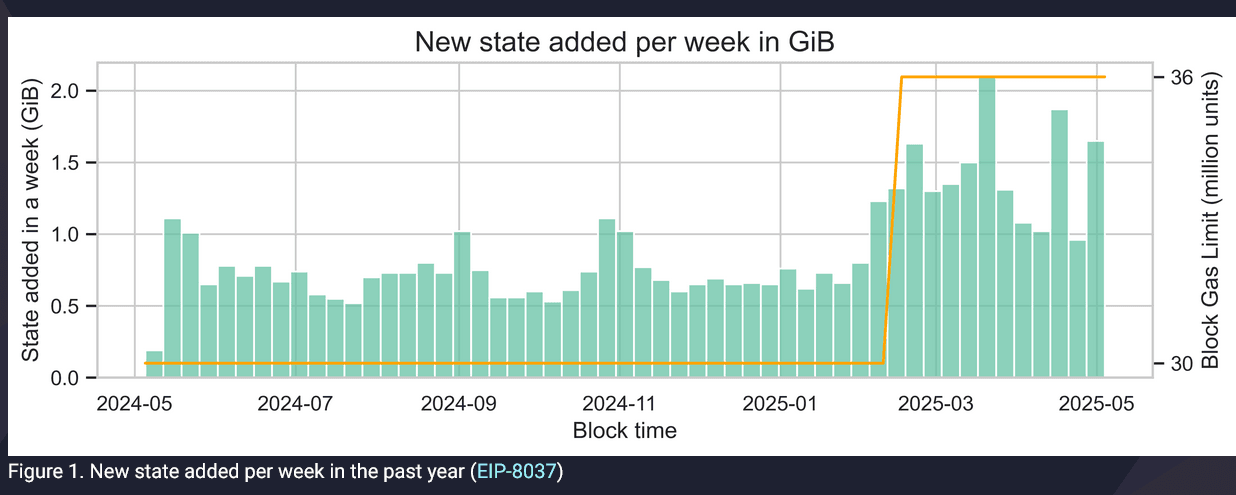 Ethereum State: Image Source: Ethereum Foundation
Ethereum’s state is the sum of everything the network currently knows. That includes account balances, smart contract storage, and the bytecode that runs decentralized applications. It is the live memory of the chain.
This state underpins an ecosystem that settles billions of dollars in value and coordinates thousands of applications across DeFi, NFTs, gaming, and enterprise use cases. The problem is simple but severe: the state only grows. Nothing ever gets removed.
As more applications deploy contracts and more users interact with them, the state expands permanently. Every full node must store and serve this data, even if large portions of it are never touched again.
Why Ethereum State Bloat Threatens Decentralization
Running a full Ethereum node is already expensive. Storage requirements keep rising, sync times increase, and serving data becomes more fragile as the chain ages. According to the Foundation, if the state becomes too large or too complex to serve, the entire stack becomes more centralized and more brittle.
Recent scaling upgrades have unintentionally accelerated this trend. Layer 2 expansion, EIP-4844 proto-danksharding, and higher gas limits all enable more activity on Ethereum. More activity means more contracts, more storage writes, and faster state growth.
The concern is not theoretical. Researchers are actively stress-testing scenarios to understand when state size becomes a bottleneck, when nodes struggle to stay synced with the head of the chain, and when client implementations start failing under extreme storage pressure.
If only a small group of well-funded operators can afford to run full nodes, Ethereum’s censorship resistance and neutrality start to weaken.
Stateless Validation Solves One Problem and Creates Another
Ethereum’s long-term roadmap includes statelessness, where validators can verify blocks without storing the full state. This significantly lowers the burden on validators and opens the door to higher throughput.
But it raises a new question: if validators do not store the state, who does?
In a stateless design, most historical and active state would likely be held by specialized operators such as block builders, RPC providers, MEV searchers, and block explorers. That concentration introduces new risks around censorship, availability during outages, and resilience under regulatory or external pressure.
The Stateless Consensus team is clear about the trade-off. Stateless validation improves scalability, but without careful design, it could push Ethereum toward infrastructure centralization.
Three Proposed Paths to Tackle State Bloat
To address the problem, the Ethereum Foundation researchers outlined three complementary approaches, each attacking state growth from a different angle.
State Expiry
State Expiry focuses on removing inactive data from the active state. The team estimates that roughly 80 percent of Ethereum state has not been touched in over a year, yet every node is still required to store it.
Under this model, inactive data is expired from the active set but can be revived later using cryptographic proofs. Two variants are being explored. One marks and expires rarely used entries with an option to revive them later. The other groups state into eras, freezing older eras while keeping recent data active.
The goal is simple: stop forcing every node to carry data that nobody is using.
State Archive
State Archive separates hot state from cold state. Frequently accessed data remains fast and bounded, while older data is preserved in archival storage for historical verification.
This approach allows node performance to remain relatively stable over time instead of degrading as the chain ages. Even if total state continues to grow, the operational burden on most nodes would stay manageable.
It also creates clearer roles between nodes optimized for performance and nodes optimized for history and research.
Partial Statelessness
Partial Statelessness allows nodes to store only subsets of the state instead of everything. Wallets and light clients would cache the data they rely on, reducing dependence on centralized RPC providers.
This model lowers storage costs, broadens participation, and makes it easier for individuals and smaller operators to run nodes without massive hardware investments.
Across all three approaches, the unifying goal is to reduce state as a performance bottleneck, lower the cost of holding it, and make it easier to serve.
What the Ethereum Foundation Is Doing Next
The Foundation is prioritizing solutions that can deliver real benefits today while remaining compatible with more ambitious protocol changes in the future. Current focus areas include improving archive node tooling, strengthening RPC infrastructure, and making partial stateless nodes easier to run.
These efforts are deliberately practical. The team emphasized that they were chosen because they are immediately useful and forward-compatible with Ethereum’s longer-term roadmap.
Developers, node operators, and infrastructure teams are being invited to participate in testing and discussion. The researchers made it clear that this is not something the Foundation can solve alone.
A Proposal, Not a Final Decision
The Foundation was careful to stress that this work represents a proposal, not a unified organizational stance. Ethereum’s protocol development includes a wide range of opinions, and no single path has been locked in.
That openness is consistent with the Foundation’s recent push to communicate more clearly about long-term protocol direction. Alongside state management research, Ethereum is also working on an Interop Layer to make Layer 2 networks feel like a single chain, rolling out leadership and R&D changes, adjusting its treasury strategy, and moving to a twice-yearly hard-fork schedule with Fusaka.
Why This Matters Long Term
Ethereum State bloat is not a headline-grabbing issue, but it sits at the heart of Ethereum’s decentralization promise. If running a node becomes too costly or complex, the network risks drifting toward infrastructure concentration, even as throughput and usability improve.
The Ethereum Foundation’s message is straightforward. Scaling the chain without scaling its ability to store and serve data safely is not enough. How Ethereum manages its state over the next few years will shape who can participate, who controls infrastructure, and how resilient the network remains under pressure.
The debate is just beginning, and the choices made here will echo far beyond the next upgrade cycle.
You May Also Like

Crossmint Partners with MoneyGram for USDC Remittances in Colombia

Why Peter Brandt Says The US Crypto Bill Won’t Be A Game-Changer